Founded in 2024, FrequenSync Therapy transforms neuroscience into practical tools for emotional regulation and resilience.
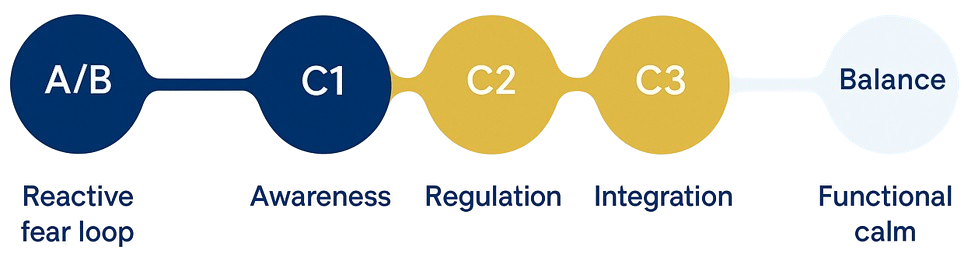
By retraining how the brain interprets fear, FQST turns discomfort into data — creating a new rhythm of awareness and balance.
FQST was established in 2024 as a global movement to integrate neuroscience and human resilience.
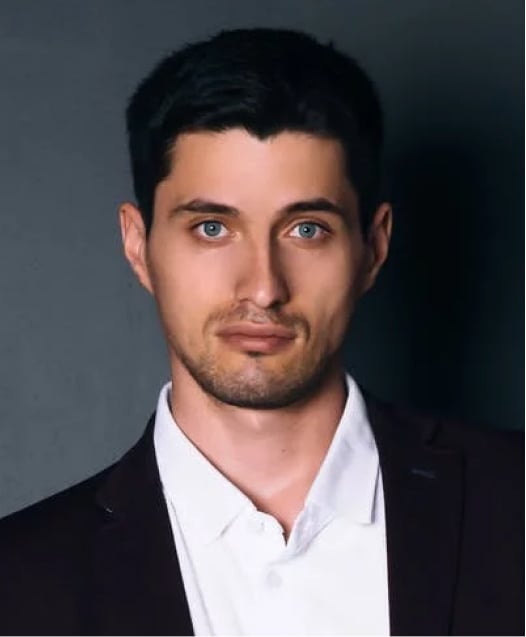
Developed through interdisciplinary research led by Henry He, the model redefines fear — not as dysfunction, but as data.
From its founding, the FQST Association has focused on translating scientific knowledge into accessible training and therapeutic systems worldwide.
As the founder and president of the FrequenSync Therapy International Association, Henry He bridges science and humanity.
His background in psychology, neuroscience, and education inspired the creation of a model that unites emotion, cognition, and rhythm.
“The mind learns best through rhythm, not resistance.”
— Henry He
FQST builds upon the strengths of Cognitive Behavioral Therapy by extending regulation beyond thoughts — into body and frequency.
Initial research on fear, rhythm, and neural retraining begins. Early experiments in cognitive frequency mapping were conducted.
Pilot program in China validated FQST’s core modules. The first learning Potocol was established.
FrequenSync Therapy International Association (FQST) founded. Training models expanded to multidisciplinary clinicians worldwide.
FQST becomes an international collaborative network advancing emotional regulation through neuroscience and art.
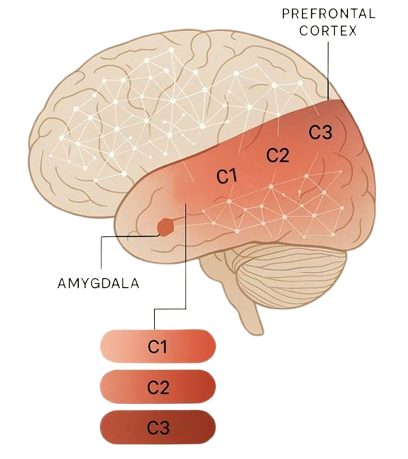
FQST reframes emotional discomfort as measurable frequency — a rhythmic neural signal that can be retrained.
The brain rewires through experience and labeling.
FQST restores balance between fear and rational control.
Bodily sensations are retrained as data, not threat.
Language reconnects logic with emotion.
Neural coherence is achieved through rhythmic awareness.
FQST synthesizes decades of psychological science into a unified, neuroscience-driven framework. By aligning body signals, cognitive interpretation, and rhythmic frequency awareness, it bridges the gap between established therapies and a new frontier of adaptive regulation.
| Therapeutic Model | FQST Integration & Innovation |
|---|---|
| Cognitive Behavioral Therapy (CBT) | Moves beyond thought restructuring into frequency recognition — teaching learners to identify and reframe neural “vibration states” rather than only cognitive distortions. |
| Acceptance & Commitment Therapy (ACT) | Extends acceptance into neuro-rhythmic alignment. Instead of merely accepting emotions, FQST helps synchronize physiological signals and mental interpretation. |
| Paradoxical Theory of Change | Retains its core principle — “change through awareness, not force” — but introduces Frequency Observation, where awareness is measured in dynamic body–mind patterns. |
| Exposure Therapy | Evolves exposure into Frequency-Based Desensitization — structured re-engagement with fear cycles in timed, wave-like intervals that restore balance. |
Unlike traditional methods that separate cognition and sensation, FQST integrates both through a frequency-based model of awareness.
FQST builds upon the strengths of Cognitive Behavioral Therapy by extending regulation beyond thoughts — into body and frequency.
Henry He, an Australian-registered mental-health nurse, counselor, educator, and researcher, turned his own anxiety journey into a lifelong mission to make mental-health support scientific and stigma-free.
From frontline nurse to innovator, Henry developed FrequenSync Therapy (FQST) through years of clinical work and research across Australia and China. In 2024, he founded the FQST International Association (Hong Kong) to unite researchers and practitioners worldwide.
“FQST is not just a system. It is a way for people to reclaim their inner strength and transform fear into growth.” — Henry He
Help bring neuroscience-based emotional learning to communities around the world.